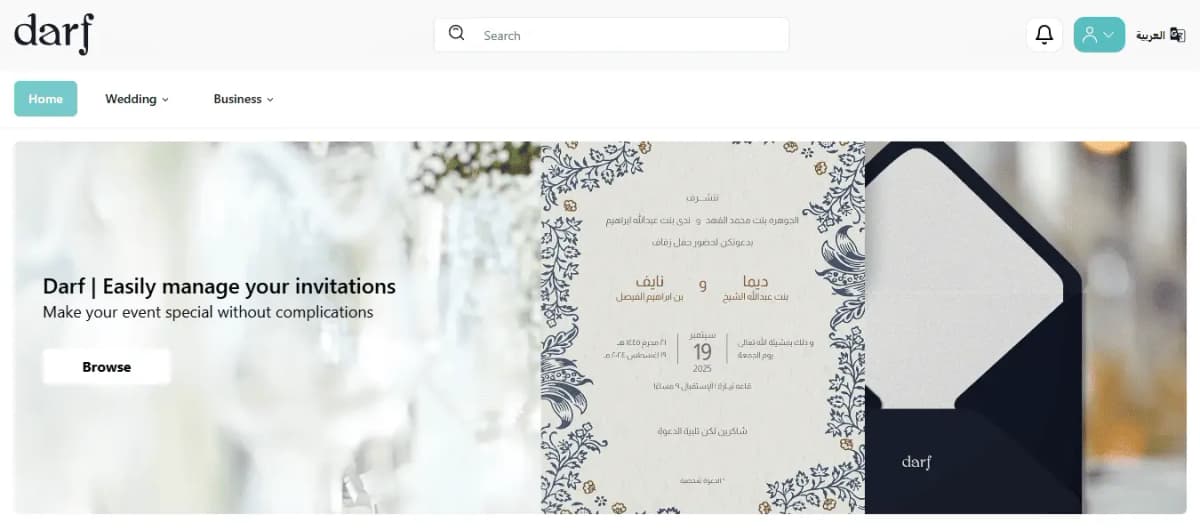
Darf (Invitation Management System)
Project Overview
Darf allows users to create and share personalized online invitations in just a few clicks. It's fast, convenient, and helps save time and effort.
React.js - JavaScript - Tailwind CSS
Arabic - English
Key Objectives
- 01
Build a fully functional and user-friendly system to manage invitation creation and distribution.
- 02
Simplify a complex workflow by transforming it into a clean, reusable, and scalable React-based solution.
- 03
Integrate bilingual support (Arabic and English) through i18n to serve a diverse user base.
- 04
Provide consistent UI/UX elements across the application with a polished look and feel aligned with the brand.
Challenges Solved

- 01
Handled a poorly structured and unorganized codebase, which lacked modularity and maintainability.
- 02
Tackled the steep learning curve of Fabric.js, which was used extensively in the project despite limited documentation and resources.
- 03
Replaced an inconsistent toast system with react-hot-toast to align with the app’s design aesthetics and color scheme.
- 04
Faced difficulty in finding relevant solutions through conventional documentation, leading to intensive use of AI tools (ChatGPT, Cursor, DeepSeek) for technical discovery.
- 05
Resolved performance bottlenecks by minimizing unnecessary component re-renders and reducing the number of components in the DOM tree.
From concept to production — built to perform and designed to impress.
Responsibilities

- -
Refactored the existing architecture by creating reusable components and converting bloated structures into clean, modular code.
- -
Reduced excessive component count (~700–800) significantly by restructuring logic and separating concerns efficiently.
- -
Wrote clear and consistent code comments to improve readability and maintainability for future developers.
- -
Integrated i18n for seamless bilingual support throughout the application.
- -
Unified the structure of section headers to deliver a cohesive layout experience.
- -
Applied custom logic for Fabric.js canvas manipulation to handle dynamic user inputs for invitation designs.
- -
Managed design constraints and user permissions (admin vs. regular users) using conditional logic within the editor.
- -
Conducted thorough cross-browser and cross-device testing to ensure responsive design compatibility.
Key Features
Customizable Canvas with Fabric.js
Allowed users to edit stickers, logos, and text directly on a live preview canvas.
Reusable Components Architecture
Boosted scalability and maintainability across the project.
Bilingual Support (Arabic & English)
Full localization using i18n with RTL/LTR layout switching.
Theme-Aware Toast Notifications
Used react-hot-toast to reflect brand colors and maintain consistent styling.
Inline Comments & Clean Code
Enhanced developer clarity and future maintainability.
Admin-Specific Canvas Controls
Ensured restricted functionalities only accessible to admin users.
Optimized Performance
Reduced unnecessary renders and heavy state updates by isolating logic efficiently.
AI-Powered Research Approach
Resolved complex implementation gaps using ChatGPT, Cursor, and DeepSeek.
Toolkit
A modern, production-grade stack chosen for performance, type safety, and developer experience.







Key Outcomes
- 01
Achieved a 40% reduction in user effort by streamlining the invitation creation process and automating repetitive tasks.
- 02
Significantly improved code readability and scalability, paving the way for future features and enhancements.
- 03
Delivered a visually consistent and polished user interface, increasing user satisfaction and engagement.
- 04
Enhanced internal collaboration by writing maintainable code with extensive inline documentation.
- 05
Successfully implemented an advanced editor powered by Fabric.js, despite limited external support or tutorials.
- 06
Demonstrated high self-sufficiency and proactive research capabilities through intensive use of AI-assisted development tools.
Other Projects
Let's work together
Have an idea, a project, or a challenge you want to bring to life? Let’s turn your vision into a modern, high-performing digital experience that looks great, feels effortless to use, and is built to make a lasting impact.